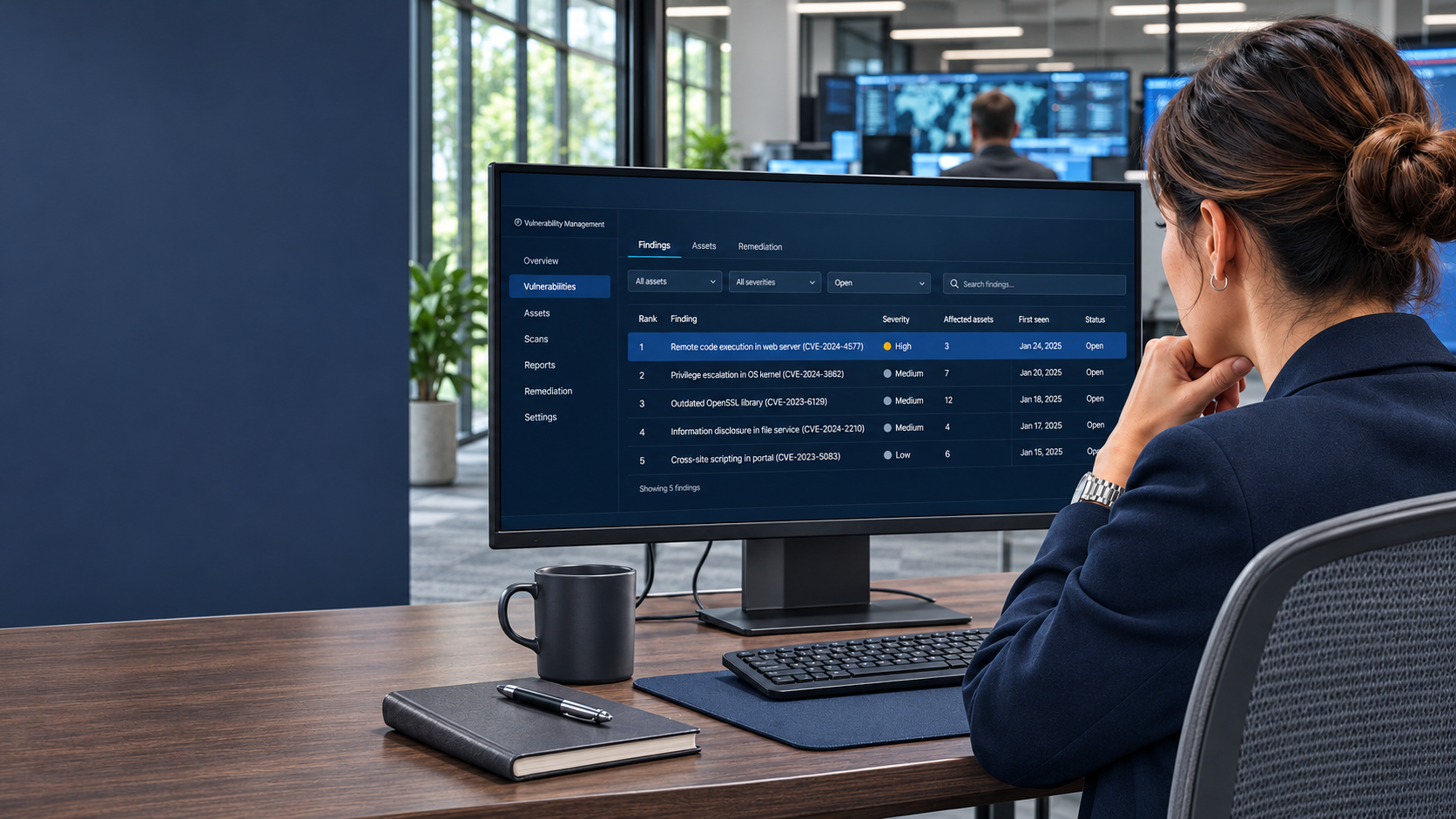
Vulnerability Assessment Found Weaknesses? What to Fix First
Nov 12, 2026 • 5 min read
Your Vulnerability Assessment Found Security Weaknesses. What Should Your UAE Business Fix First? | Vulnerability Assessment Services in UAE
Fix the weaknesses attackers are already using first, starting with the systems they can reach from the internet, and schedule everything else.
You have the report. Maybe it lists 40 findings, maybe 400, and half of them say “critical”. Nobody can fix all of that this week, and trying to is how teams get worn out and still miss the one that matters. This guide shows how UAE businesses can decide what to fix first, who should fix it, and how to stop the same problems coming back.
Vulnerability assessment services in the UAE find, evaluate and prioritise weaknesses across your IT infrastructure, cloud environments and applications. The prioritising step is where most reports stall, and it is where this guide starts.
What Does a Vulnerability Assessment Cover Before You Get Your Report?
A typical assessment covers your external attack surface, your internal network, your cloud settings, and your web applications and APIs, and it should end with a fix plan and a retest. In more detail:
- External attack surface: internet-facing systems, exposed services, DNS records and SSL certificates
- Internal network: authenticated scans and checks of Active Directory
- Cloud settings: access rules, storage and container set-up in AWS, Azure and Google Cloud
- Web applications and APIs: automated and manual checks of the apps and connections that customers and partners use
- Compliance mapping: findings linked to the standards that apply to you, such as UAE IA (NESA) or ISO 27001
The usual steps are scoping and asset discovery, scanning with analyst checks to remove false alarms, risk scoring, and a fix plan followed by a retest. Our guide to vulnerability assessment services in UAE goes through them. The rest of this article starts where the report lands.
Why Is Finding Vulnerabilities Only the First Step?
Finding a weakness does not reduce your risk. Fixing it does. A report is a list of problems, and your risk stays exactly the same until somebody closes them.
The numbers show the gap. A summary of the State of the UAE Cybersecurity Report 2025 says over 223,800 assets in the UAE were exposed, and that half of critical vulnerabilities had gone unaddressed for more than five years. At GISEC 2026, experts listed weak threat prioritisation among the common oversights they keep seeing in the cloud. Many businesses know about their weaknesses. The hard part is deciding what to fix and then doing it.
Does Every Critical Vulnerability Need Fixing Immediately?
No. “Critical” tells you how bad a weakness could be, not how urgent it is for your business. A CVSS score measures severity in general terms. It does not know whether the system is on the internet, whether it holds customer data, or whether attackers are using the flaw today.
A critical flaw on an isolated test server can wait. A medium flaw on your payment website might not.
How Do You Prioritize Vulnerabilities Based on Business Risk?
Rank each finding by how active, how likely, how exposed and how valuable it is. Five questions help:
- Is it being exploited now? Check the CISA Known Exploited Vulnerabilities catalog. If a weakness is listed, move it to the top.
- How likely is it to be exploited soon? EPSS estimates the chance over the next 30 days.
- Can anyone reach it from the internet? Internet-facing systems come first.
- What does the system hold or run? Payments, customer data and logins matter more than a spare test machine.
- Is there already a safety net? Network separation, multi-factor authentication or a firewall rule may lower the urgency, but do not rely on them for ever.
e.g: A Dubai retailer’s report shows a medium-severity flaw on its payment server that appears in the KEV catalog, and a high-severity flaw on an internal test machine that does not. The retailer fixes the payment server first and writes down why. (Illustrative example.)
Which Security Weaknesses Should Businesses Fix First?
Fix the weaknesses that give an attacker an easy way in before the ones that take a lot of effort to use. A sensible order is:
- Weaknesses on the KEV list, especially on internet-facing systems
- Exposed admin pages, remote access and default or weak passwords
- Missing multi-factor authentication on admin and email accounts
- Unpatched internet-facing software
- Cloud mistakes, such as public storage and permissions that are too broad. Misconfiguration was behind 32% of cyber incidents in the State of the UAE Cybersecurity Report 2025.
- Findings on your most important internal systems
- Everything else, on a planned schedule
Treat this as a starting point. The value of your own systems may change the order.
What Should a Vulnerability Assessment Report Include?
A useful report tells you what is wrong, where it is, how bad it is for your business and exactly how to fix it. Look for:
- A summary that a manager can read in two minutes
- The scope: what was tested, and what was not
- Each finding, with evidence and the affected systems
- A priority that goes beyond the raw severity score
- Fix steps that your team can follow
- Retest results, once the fixes are done
If yours is a long scanner export with no ranking, ask your provider for a prioritised version. Our guide on how to choose vulnerability assessment services in UAE explains what a good report looks like.
What Happens After Vulnerabilities Are Identified?
Work through five steps for every finding: confirm it, assign it, fix it, check it and record it.
- Confirm: remove false alarms before anybody spends time on them.
- Assign: give every finding one owner and a deadline that matches its priority.
- Fix or reduce: patch it, change a setting, or add a temporary control if you cannot patch yet.
- Check: rescan to confirm it is closed. A finding is not closed until a rescan says so.
- Record: keep the evidence, and write down any risk you accept, with a reason and the name of the person who approved it.
If you take card payments, PCI DSS expects high-risk and critical findings from internal scans to be fixed and rescanned. The PCI Security Standards Council publishes the standard. Our guide on mistakes UAE businesses make after a security assessment also helps with owners and deadlines.
How Can You Stop the Same Vulnerabilities From Coming Back?
Fix the cause, not just the finding. If the same issues keep appearing, look at the habits behind them:
- Know what you own: keep a current list of systems, because you cannot fix what you do not know about.
- Patch on a routine: see our guide to patch management in Dubai.
- Use secure settings: agree a standard setup for new servers and cloud services.
- Limit admin rights: see how to remove local admin rights without slowing your team down.
- Scan after big changes: do not wait for the next scheduled scan.
- Track three simple numbers: open findings by priority, time taken to fix, and findings that keep coming back.
How Often Should UAE Businesses Run a Vulnerability Assessment?
Run one whenever your environment changes in a big way, and on a regular schedule in between. PCI DSS asks for scans at least every three months and after significant changes. ISO 27001 leaves the schedule to your own policy.
If your systems change often, a quarterly rhythm is a good place to start. Add an extra assessment after a new application, a cloud move or a new office. Our post on vulnerability assessment services in UAE explains what an assessment covers.
How Can Agile ManageX Help You Fix What Matters First?
We run vulnerability assessments for UAE businesses and turn the findings into a ranked fix list that your team can act on. Our analysts review the scan results to remove false alarms and add business context, and retesting is available to confirm that important findings are closed. If you already have a report and are not sure where to start, talk to our team and we will help you sort it.
What Should You Do This Week?
Pick your top ten, give each one an owner and book the rescan. Filter your report for anything on the KEV list and anything on internet-facing systems. Agree who fixes what, and by when. Then put the rescan date in the calendar before you close the report. Small, finished fixes beat a perfect plan that nobody starts.
FAQs
What should I do after a vulnerability assessment?
Sort the findings by risk, give each one an owner and a deadline, fix the highest-risk ones first and rescan to confirm that the fixes worked.
Is a CVSS score enough to prioritise vulnerabilities?
No. It is a starting point. Add whether the weakness is being exploited, how likely exploitation is, whether the system is exposed and how valuable it is to your business.
Can we ignore low-severity findings?
Not for ever. Plan them into routine maintenance, and look at them sooner if they sit on important systems. Record any risk you decide to accept.
Who should fix vulnerabilities, our IT team or the provider?
Usually your IT team or system owners, because they run the systems. A provider can explain each fix, help plan the work and retest afterwards.
Do we need to rescan after fixing?
Yes. A rescan is the only way to know the fix worked. PCI DSS also expects it for high-risk and critical internal findings.